
Modern Japanese painting and Japanese Western-style painting have undergone major changes due to Westernization, but one of their defining characteristics is that many of their works display a unique individuality that makes it clear which Japanese artist created them. These works continue to shine today. This exhibition will introduce artists who were at the forefront and central to their era, leading the way into the next.
He opened the door to modern Japanese painting and devoted himself to mentoring the next generation of artists, including Kawai Gyokudō, Yokoyama Taikan, and Hishida Shunso.
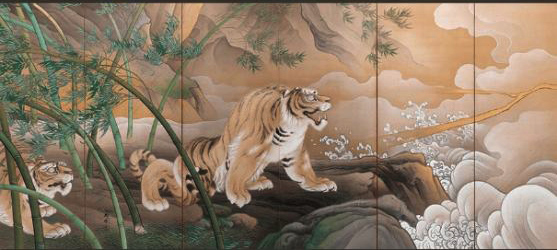
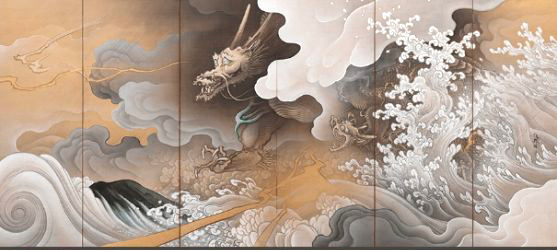
橋本雅邦「龍虎図屏風」1895年
Gaho Hashimoto "figure of dragon and tiger screen" 1895
江戸に生まれ、12歳から木挽町の狩野勝川院雅信に学び、幕末の狩野派は当時粉本主義に陥っていたが、雅邦は円山四条派を学びながら独創的表現を模索していた。
明治維新により西洋絵画に本格的に触れ、奥行きある立体的表現をどのように日本画に取り入れるか狩野芳崖と共に狩野派の画法を基に取り組んでいった。
さらにフェノロッサ、岡倉天心の理論を支柱とした新しい近代の日本画を作り上げ、
日本美術院の主幹として川合玉堂、横山大観、菱田春草らの後進の指導にも尽力した。
Born in Edo, he studied under Kano Katsukawain Masanobu of Kobi kicho from the age of 12. While the Kano school of painting at the end of the Edo period had fallen into the trap of copying traditional Japanese painti ng, Gaho studied the Maruyama-Shijo school and sought original forms of expression.
With the Meiji Restoration, he began to fully explore Western painting, and together with Kano Hogai, he worked to incorporate d eep, three-dimensional expression into Japanese painting, based on the Kano school's p ainting techniques.
He also created a new style of modern Japanese painting based o n the theories of Fenollossa and Okakura Tenshin, and as a director of the Japan Art Academy, he devoted himself to m entoring younger artists such as Kawai Gyokudō, Yokoyama Taikan , and Hishida Shunso.
Two masters who played a major role in the innovation of modern Japanese painting.
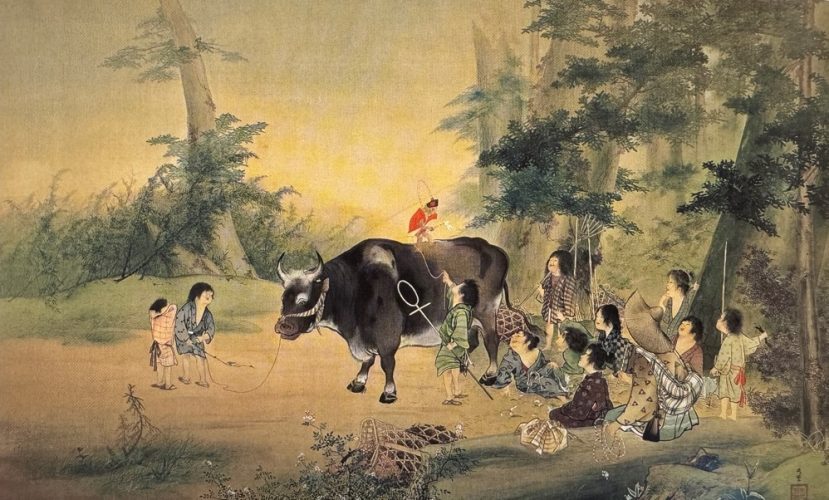
横山大観「村童観猿翁」1983年
Taikan Yokoyama "outlook on village children monkey old man" 1983
東京美術学校の卒業制作
猿回しの翁を恩師橋本雅邦に見立て、11人の村童を級友の子どのも頃の顔を想像して描いた。
大観の着想のユニークさが際立つ作品。
Graduation production of the Tokyo Bijutsu school I likened the old man of the monkey trainer to teacher Gaho Hashimoto and I imagined a face of child どのも of the classmate and drew 11 village children. The work that the uniqueness of the idea of the broad perspective stands out.
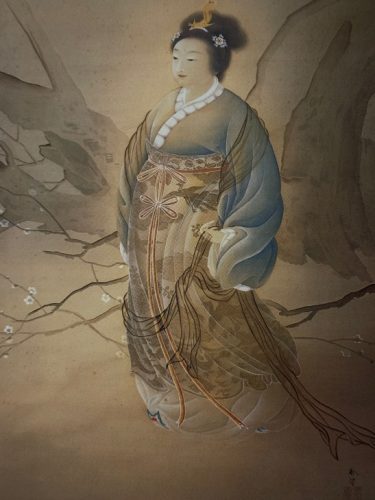
菱田春草「羅浮仙」1901年
Shunso Hishida " Ra fuse n " 1901
中国古事を主題に描かれた本作は、梅の精「羅浮仙」を描いたもの。
光や色彩のコンタラストを使ってほのかに人物を浮かび上がらせている従来の日本画にはない西洋画的描写を使った逸品。
This product that Chinese folk history was described in the subject is a thing about spirit "Ra fuse n" of the plum. A gem using the description of the Western painting faintly few using the contrast of light and the color in a conventional Japanese painting letting a person appear.
明治維新以降では欧化主義の風潮の中ではあったが、美術では逆に急速な欧化政策の反動として国粋主義の風潮が高まっていった。
日本伝統絵画の優位性を主張したフェノロサは狩野芳崖を選び狩野派の伝統絵画から近代に相応しい絵画を創出しようと1889年岡倉天心と共に東京美術学校を開校した。
1期生として横山大観、3期性で菱田春草が入学する。
その後明暗、空気感などを求め朦朧体と呼ばれた線描がはっきりしない技法を取り入れるなど新しい技法にチャレンジしていく。
岡倉天心は美術学校では狩野派を中心に日本の伝統的な絵画教育を行う中、もっと広がりを持たせるに西洋的なものを取り入れなければならないという考え方をしていた。
「美術はアイデアである。理想でいかなければならない。写生に行っては芸術は衰える」との岡倉の考えを大観、春草は引き継ぎ実践していく2人は近代日本画の草創期の偉大な画家である。
Following the Meiji Restoration, there was a climate of Western ization, but in art, a trend of nationalism grew as a backlash to the rapid Westernization policy.
Fenollosa, who advocated the superiority of traditional Japanes e painting, chose Kano Hogai and, in 1889, opened the Tokyo Sch ool of Fine Arts together with Okakura Tenshin, in an attempt to create paintings that we re more suited to the modern era from the traditional paintings of the Kano school.
Yokoyama Taikan enrolled as a student in the first class, and Hi shida Shunso in the third.
Subsequently, the school began to experiment with new technique s, such as incorporating a style of vague line drawing known as the Mondo-tai style, which sought to create a sense of light and shadow and atmosphe re.
While Okakura Tenshin taught traditional Japanese painting at his art school, focusing on the Kano school, he believed that W estern elements n eeded to be incorporated to broaden the curriculum.
"Art is an idea. It must be based on ideals. If it turns to ske tching, art will decline," Okakura's ideas were taken up and pu t into practice by Taikan and Shunsō, and these two are great painters from the early days of modern Japanese painting.
因習的なものとなっていた日本画を打破しようとする日本画の近代化はその原点を狩野派にとり、これに改良を加える形で始められていた。
安田靫彦はそうした新しい動きに敏感に反応しながらも、新進気鋭の横山大観、下村観山、菱田春草ら院展第一世代など狩野派系のもとに置かず、紫紅会という研究会を作り大和絵を出発点とする日本画として近代化をはかっていった。
そこに盟友となる今村紫紅が会に入り、名称を「紅児会」に改称し共に研鑽に励みそれぞれの画風を確立していった。
また紅児会には小林古径、前田青邨、速水御舟など日本画の近代化に重要な仕事を成し遂げた人材を多く輩出した。
1907年安田靫彦は岡倉天心に認められ日本美術院研究所にまぬかれ、また今村紫紅も靫彦の推挙で天心に「君は古人では誰を好むか」と聞かれた際「俵屋宗達」と答え、天心に研究所での制作に参加することを承諾された。
その紫紅は印象派の色彩や琳派の技法など自由に取り入れるなど新画法に挑み、靫彦は「新古典主義」とも言える明るく豊かな色彩と写実をふまえたおおらかな造形の作風を新しい日本画に与えていった。
The modernization of Japanese painting, an effort to break away from conventional Japanese painting, began with improvements to its roots in the Kano school.
Yasuda Yukihiko was keen to respond to this new movement, but instead of placing the up-and-coming artists of the first genera tion of Inten artist s, such as Yokoyama Taikan, Shimomura Kanzan, and Hishida Shunso, under the w ing of t he Kano school, he formed a s tudy group called t he Shiko-kai and sought to m odernize Japanese pa inting u sing Yamato-e as its starting point.
His ally Imamura Shiko joined the group, which was renamed the Koji-kai, and together they devoted themselves to study and est ablished their own styles.
The Koji-kai also produced many talented artists who achieved i mportant work in the modernization of Japanese painting, includ ing Kobayashi Kokei, Maeda Seison, and Hayami Gyoshu.
In 1907, Yasuda Yukihiko was recognized by Okakura Tenshin and admitted to the Japan Art Academy Research Institute, and Imamu ra Shiko was also recommended by Yukihiko. When Tenshin asked him, "Who of the ancients is your favorite?" he answered "Tawaraya Sōtatsu," and Tenshin agreed to let him participate in the institute's productions.
Shiko took on new painting techniques, freely incorporating Imp ressionist colors and Rinpa techniques, while Yukihiko brought a new style of bright, rich colors that could be called "neoclassical" and a g enerous form based on realism to Japanese painting.

安田靫彦 1940/41「黄瀬川陣」
Yukihiko Yasuda 1940/41 "Kise River formation"
源頼朝、義経の20 年ぶりの兄弟対面を描く東京国立近代美術館所蔵、図録より
Than Yoritomo Minamoto, National Museum of Modern Art, Tokyo po ssession, the pictorial record representing the first brothers meeting of Yoshitsune in 20 years.

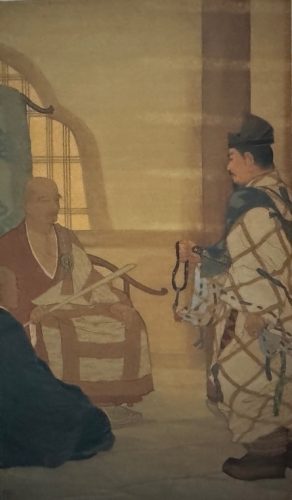
今村紫紅 1908年「時宗」
The Shiko Imamura 1908 "Jishu"
時宗が中国から招いた禅僧 祖元
東京国立近代美術館所蔵、図録より
mugaku son gen which the Jishu sect caused from China Than National Museum of Modern Art,Tokyo possession, pictorial record.
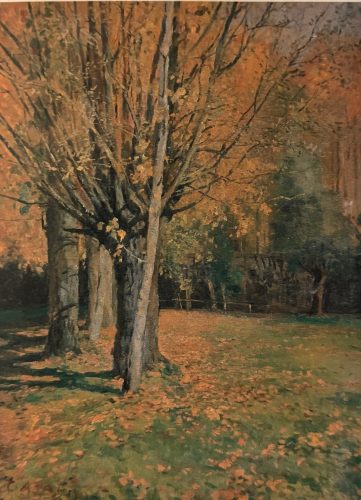
浅井忠「グレーの秋(落葉)」1901年東京国立博物館蔵 当館図録より
Than Chu Asai "autumn (fallen leaves) of the gray" 1901 Tokyo N ational Museum storehouse this museum pictorial record.
1856年佐倉藩の江戸屋敷に生まれる。1876年工部美術学校画学科に入学しイタリア人教師フォンタネージに師事する。
当時は西南戦争を機に盛り上がった国粋主義の思潮は洋画を排除する時代ではあったが1889年の明治美術会に尽力し中心的存在として活躍した。
その中、1896年にフランスから帰国した黒田清輝はその明るい外光の作風で新派と呼ばれ脚光を浴びていった。
黒田清輝は白馬会を結成や東京美術学校西洋画科教授に任命される活躍で一躍躍り出た。
浅井忠はその2年後の1898年東京美術学校教授に任命されるも文部省からの命で渡欧、パリ滞在中に「グレーの秋」「グレーの洗濯場」など今までなかった新たな油彩、水彩の技法で名作を残していった。
帰国後は京都高等工芸学校教授に転任し、1902年の帰国後聖護院洋画研究所を開設し、その後京都の洋画会に中心的存在として活躍し、梅原龍三郎、安井曽太郎など輩出し関西洋画壇の振興に努めた。
Born in 1856 in the Edo residence of the Sakura domain.
In 1876, he entered the Painting Department of the Kobu Bijutsu Gakko (Technical Art School) and studied under the Italian tea cher Fontanesi.
At the time, the nationalistic trend that had risen in the wake of the Seinan War was pushing Western-style painting to the exclusion of Western painting, but he contributed greatly to the Meiji Art Association of 1889 and played a central role.
Amid this, Kuroda Seiki, who returned from France in 1896, came into the spotlight for his bright, plein-air painting style, w hich earned him the nickname "New School."
Kuroda Seiki rose to prominence with his formation of the Hakuba-kai (White Horse Society) and his appointment as professor of Western Painting at the Tokyo School of Fine Arts.
Two years later, in 1898, Asai Chu was appointed professor at t he Tokyo School of Fine Arts, but was ordered by the Ministry o f Education to travel to Europe. During his time in Paris, he created masterpieces using unprecedented oil and watercolor techniques, such as "Gray Aut umn" and "Gray Laundry." After returning to Japan, he was transferred to a professorship at the Kyoto Higher Technical School, and after returning to J apan in 1902, he opened the Shogoin Western Painting Institute. He subsequently played a ce ntral role in the Western Painting Society of Kyoto, producing artists such as Umehara Ryuzaburo and Yasui Sotaro, and working to promote the Kansai W estern painting world.
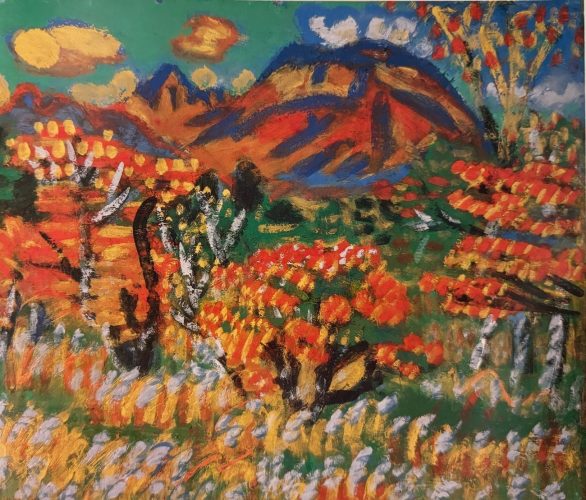
梅原龍三郎「浅間山」1956年東京国立近代美術館蔵 当館図録より
Than Ryuzaburo Umehara "Mount Asama" 1956 National Museum of Mo dern Art, Tokyo storehouse this museum pictorial record.
1888年京都に生まれ15歳で聖護院洋画研究所に入所し浅井忠の指導を受けた。同時期には安井曽太郎も学んでいる。
1908年フランスに留学し巨匠ルノアールに師事し、数年にわたるフランス留学で壮大な豪奢な作品を生む素養を身につけていった。
1934年から度々鹿児島に行って桜島や霧島など季節や角度、時刻を変えて描き続けた「桜島」「霧島」など連作を描く。
また、1939年から43年までの5年間に6回もの北京滞在を重ねて「長安街」「北京秋天」など描くも戦況の悪化で1945年伊豆に疎開し、富士山を題材にその後10年に渡り描き続けた戦後は東京美術学校教授を辞任し、毎年のように南仏ではカンヌ、夏は長野県軽井沢に山荘を作り浅間山を題材に連作を自由に描き続けた1973年フランス芸術文化勲章コマンドール賞を受賞日本の洋画壇を80年に渡り先導し続けた。
Born in Kyoto in 1888, he entered the Shogoin Western Painting Institute at the age of 15 and studied under Asai Chu. At the s ame time, Yasui Sotaro also studied there.
In 1908, he went to France to study under the master Renoir, and over the course of several years he acquired the skills to create magnificent, extravagant works.
From 1934, he frequently traveled to Kagoshima, where he painte d series such as "Sakurajima" and "Kirishima," depicting Sakura jima and Kirishima in different seasons, angles, and times.
He als o stayed in Beij ing six ti mes over the fi ve years from 1939 to 1943, paintin g w orks su ch as "Ch ang'an St reet" and "Autumn in Beijing." However, as the war situation worsened, he evacuated to Izu in 1945, where he continued to paint Mount Fuji for the next ten years. After the war, he resigned from his position as a professor at the Tokyo School of Fine Arts, a nd every year he traveled to Cannes in the south of France, and in the summer he built a mountain villa in Karuizawa, Nagano Prefecture, where he contin ued to paint series of works freely, featuring Mount Asama. In 1973 he was awarded the Commandeur de l'Ordre des Arts et des Lettres by the French gov ernment, and continued to lead the Japanese Western-style paint ing scene for 80 years.
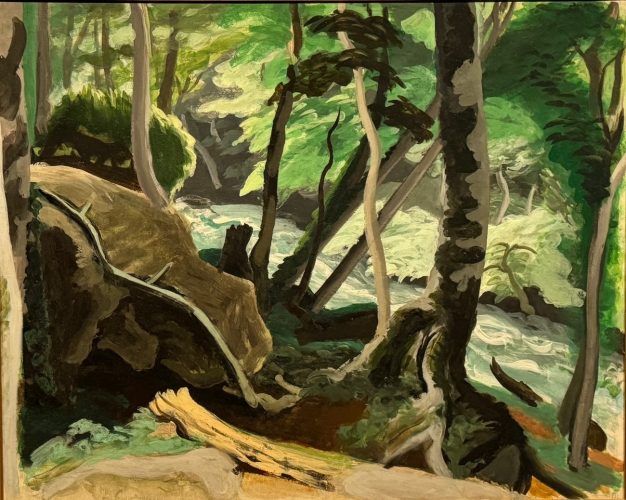
安井曽太郎「奥入瀬の渓流」1933年東京国立近代美術館蔵 当館図録より
Than Sotaro Yasui "mountain stream of Oirase" 1933 National Mus eum of Modern Art, Tokyo storehouse this museum pictorial record.
1888年京都市に生まれる。
1904年聖護院洋画研究所に入所し梅原龍三郎と共に浅井忠の指導を受ける。
1907年にパリに留学しアカデミー・ジュリアンに入学するピサロの作品から光と明るい色彩を学び、セザンヌの作品にふれて実在感の意味を知ることでリアリズムへ想いが彼の写実表現を推し進めた。
風景画では千葉県太海での1931年「外房風景」を、国立公園協会に依頼された十和田湖での「奥入瀬の渓流」などを、また人物では1934年の二科展に出品された「金蓉」「T 先生の像」などが賞賛されている。
Born in Kyoto in 1888.
In 1904, he entered the Shogoin Western Painting Institute and studied under Asai Chu along with Umehara Ryuzaburo.
In 1907, he studied in Paris and enrolled at the Académie Julian. He learned about light and bright colors from the works o f Pissarro, a nd his encounter with Cézanne's work, which taught him the meaning of reality, f urthering his desire for realism and realistic expression.
His landscape paintings include "Outer Boso Landscape" (1931) i n Futomi, Chiba Prefecture, and "Oirase Mountain Stream" (1932) at Lake Towada, commissioned by the National Parks Association.
His portraits, such as "Kinrong" and "Portrait of Professor T," both of which were exhibited at the Nika Exhibition in 1934, a re highly acclaimed.